 |
 |
Thursday 27 november 2025
The Uber taxi picks us up at 2:00 PM and takes us to Rotterdam Airport in half an hour. Our Transavia flight to Valencia departs at 5:35 PM and arrives in Valencia fifteen minutes earlier than scheduled (6:35 PM instead of 6:50 PM). The luggage rolls off the belt within minutes, and we can continue on our way, except that the taxi driver we booked isn't there yet. He doesn't arrive until 7:20 PM. Then we drive through Valencia's evening rush hour to our Airbnb in the old city center.
The city center is lively, even though it's quite chilly in the evening. We go grocery shopping at the nearby Carrefour Express. The restaurants and terraces in the area are very noisy, as are the street buskers. Fortunately, at midnight it's almost silent.
Weather: dry, 8ºC
Friday 28 november 2025
After breakfast, we head into the city center. We start at Plaça de la
Reina, where the Cathedral is located. A sort of Christmas market has
been set up on the Cathedral Square, but it doesn't have a Christmas
atmosphere at all. We walk south to Plaça Redondo, a circular
square with shops and stalls sellin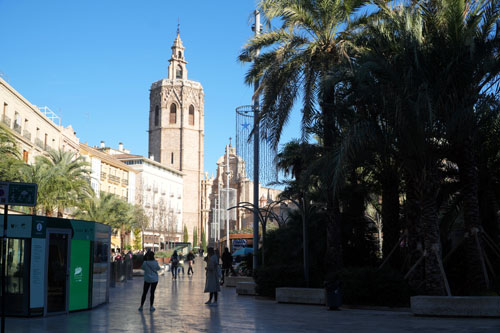 g fabrics,
ribbons, yarn, lace, and much more. We continue to Plaça de
Ajuntamient. Here stands the 19th-century City Hall. It's richly
decorated with statues and towers, but unfortunately, it's not open to
the public today because the city council is meeting.
g fabrics,
ribbons, yarn, lace, and much more. We continue to Plaça de
Ajuntamient. Here stands the 19th-century City Hall. It's richly
decorated with statues and towers, but unfortunately, it's not open to
the public today because the city council is meeting.
We continue our walk and have coffee at Café Templo, a coffee shop. The
café is filled with photos of movie stars from the 1940s and 1950s. Then
we continue to Estació del Nord station, built in 1907-1917.
It's beautifully decorated with lots of oranges. The waiting room has
beautiful tile tableaus depicting scenes from the Huerta, the
agricultural region surrounding Valencia. We walk back to the cathedral.
Originally Romanesque, the church, built in the 13th century on the
foundations of a mosque, has a strong Gothic interior. The main Holy
Grail attraction is the holy chapel containing the Holy Grail, from
which Jesus is said to have drunk during the Last Supper. The Grail is
exhibited in a separate, dark chapel, encased in a kind of monstrance.
Afterwards, you can tour the museum, where the  processional
altar is located. The church's exterior is also beautifully decorated
with lovely gargoyles and statues.
processional
altar is located. The church's exterior is also beautifully decorated
with lovely gargoyles and statues.
Around two o'clock, we have lunch at La Lola, less than a minute's walk from our
apartment. We opt for Paella Valenciana. Unfortunately, everything
inside is full, but we can sit outside on the terrace with gas heating.
The paella takes 40 minutes to prepare, and in the meantime, we enjoy a
platter of patatas bravas. It's deliciously prepared with a wonderful
dressing. The paella itself is also delicious, with a lot of chicken and
rabbit. Fish and seafood are not part of the Valencian version of
Paella.
After lunch, we return to the apartment. In the evening, we take the bus
to the Palau de
la Musica for a concert by the Valencia Orchestra. Under the
direction of Pinchar Zuckerman, they play a Haydn violin concerto and
later Beethoven's Second Symphony. The conductor is also the violin
soloist. It's striking that the audience doesn't turn in their coats at
the cloakroom – we couldn't find one at first either. And the
intermission is very short. There's barely time to order and drink
something. Most don't. Before the end, a few older audience members
leave. The bus won't wait?
We take the bus back to Plaça de la Reina.
Weather: 16ºC, sunny
Saturday 29 november 2025
After breakfast, we take a stroll through the Barrio del Carmen,
a quiet neighborhood in Valencia's old town. We walk past Plaça de Carmen, with its eponymous 13th-century
church and the Torres de Quart, a 15th-century city gate on the west
side of the old town. We walk back to the apartment.
old town. We walk past Plaça de Carmen, with its eponymous 13th-century
church and the Torres de Quart, a 15th-century city gate on the west
side of the old town. We walk back to the apartment.
In the afternoon, we have a drink at Plaça de la Reina, including a Horchata, a refreshing drink made with tiger nuts. Afterward, I walk to the ceramics museum. It's housed in the former city palace of the Duke of dos Aguas, which is named after Valencia's two rivers (Turio and Caraixet). The exhibition begins at two of the Duke's carriages and continues through the restored family palace. Attached to it is a newer museum showcasing the history of ceramics from 5000 BC to the present day. There are also some Delftware pottery pieces on display.
In the evening, we go to Restaurante
Fierro in the Ruzafa district, a bohemian neighborhood with
many good places to eat and drink. We're a bit early, so we have a drink
across from our restaurant at Olhöps. I have an  Agua de
Valencia, not just water, but a cocktail with orange juice, cava, gin,
vodka, and orange liqueur. At Fierro, we have a delicious 10-course
Torres de Quart dinner, where we seem to start with dessert (with blue
cheese and an oloroso sherry), but then experience a fantastic pairing
of wines and food. The restaurant, run by an Argentinian and Spanish
chef, has been around for ten years, and both traditions are reflected
in the menu. The 10 courses are the chefs' favorites from each year
they've been open. At this restaurant, we're told about each course
after each meal, rather than beforehand, unless we request otherwise.
After dinner, we take a taxi back.
Agua de
Valencia, not just water, but a cocktail with orange juice, cava, gin,
vodka, and orange liqueur. At Fierro, we have a delicious 10-course
Torres de Quart dinner, where we seem to start with dessert (with blue
cheese and an oloroso sherry), but then experience a fantastic pairing
of wines and food. The restaurant, run by an Argentinian and Spanish
chef, has been around for ten years, and both traditions are reflected
in the menu. The 10 courses are the chefs' favorites from each year
they've been open. At this restaurant, we're told about each course
after each meal, rather than beforehand, unless we request otherwise.
After dinner, we take a taxi back.
Weather: sunny, 15ºC
Sunday 30 november 2025
We Gulliver get up relatively late, at 9:00 a.m. After breakfast and
coffee, we head to
Gulliver Park. We take bus 94. Gulliver Park is located on the riverbed
of the diverted Turia River and is part of the Turia Park. After
a flood in 1956, the Turia River was diverted via a canal outside the
city. A park has been created in the former riverbed. A large statue of
the giant Gulliver has been erected in Gulliver Park, where
children can play, just like the Lilliputians in Jonathan Swift's book.
We rent electric bikes and cycle through the park to the end of the
river valley. The park has several sports fields where people play
soccer, rugby, and baseball. The park is over 6 km long, and several
bridges connect the two banks above us. One of these is designed by the
Valencian architect Calatrava. There are no cafes or kiosks in the park,
except for Palau de la Musica, so for a drink we have to go uphill.
After a drink in a shopping mall, we cycle back. We return the bikes and
then have lunch at a somewhat run-d
we head to
Gulliver Park. We take bus 94. Gulliver Park is located on the riverbed
of the diverted Turia River and is part of the Turia Park. After
a flood in 1956, the Turia River was diverted via a canal outside the
city. A park has been created in the former riverbed. A large statue of
the giant Gulliver has been erected in Gulliver Park, where
children can play, just like the Lilliputians in Jonathan Swift's book.
We rent electric bikes and cycle through the park to the end of the
river valley. The park has several sports fields where people play
soccer, rugby, and baseball. The park is over 6 km long, and several
bridges connect the two banks above us. One of these is designed by the
Valencian architect Calatrava. There are no cafes or kiosks in the park,
except for Palau de la Musica, so for a drink we have to go uphill.
After a drink in a shopping mall, we cycle back. We return the bikes and
then have lunch at a somewhat run-d own
restaurant. The food is good, but the furniture is past its prime. Then
we take the bus back to the city center. Oddly enough, bus 94 takes a
different route on the way back due to the one-way system, and we still
have a good 10-minute walk to our apartment.
own
restaurant. The food is good, but the furniture is past its prime. Then
we take the bus back to the city center. Oddly enough, bus 94 takes a
different route on the way back due to the one-way system, and we still
have a good 10-minute walk to our apartment.
Around 5 p.m., we go to a nearby cocktail bar, but it's not open yet. We
walk on to the tapas bar Colmada
La Lola. There we have a cocktail and eat some delicious tapas:
olives, anchovies, patatas bravas, croquettes, and three cheeses.
Delicious. Then back home.
Weather: partly cloudy, 16ºC
Monday 1 december 2025
Before breakfast, the kitchen faucet breaks.  Yet another
disappointment, following previous short circuits caused by the
dishwasher and living room light. The owner suddenly becomes
unresponsive. After a cup of coffee, we go to the covered Central
Market Hall (El Mercat Central). It's very large and beautifully
built in 1928 in Art Nouveau style. We don't buy anything, but admire
the hams, vegetables, oranges (sold here with the crown and stem), and
meat in all sorts of forms. You can also buy ready-made paella.
Yet another
disappointment, following previous short circuits caused by the
dishwasher and living room light. The owner suddenly becomes
unresponsive. After a cup of coffee, we go to the covered Central
Market Hall (El Mercat Central). It's very large and beautifully
built in 1928 in Art Nouveau style. We don't buy anything, but admire
the hams, vegetables, oranges (sold here with the crown and stem), and
meat in all sorts of forms. You can also buy ready-made paella.
We leave the market for coffee and cake. Then we go to the Lonja de
la Seda, or Silk Exchange. Silk has been traded here since the
15th century, and later other commodities as w ell.
The building consists of three parts. The most impressive is the trading
floor: a high space with a star-shaped roof supported by curling Lonja
columns. Next to it is a council chamber of the first commercial bank.
On the top floor is the Consulado del Mar, a maritime court, and in the
basement, a prison for merchants who default on their debts. The
building is beautifully decorated with some playful elements, such as a
window decoration depicting a figure exposing its buttocks and a
gargoyle urinating.
ell.
The building consists of three parts. The most impressive is the trading
floor: a high space with a star-shaped roof supported by curling Lonja
columns. Next to it is a council chamber of the first commercial bank.
On the top floor is the Consulado del Mar, a maritime court, and in the
basement, a prison for merchants who default on their debts. The
building is beautifully decorated with some playful elements, such as a
window decoration depicting a figure exposing its buttocks and a
gargoyle urinating.
Afterwards, we go to the Real Basilica de la Virgen de los
Desamperados, or the Royal Basilica of Our Lady of the Homeless,
the city's patron saint. The church is connected to the adjacent
cathedral by a bridge (for high-ranking clergy only) and features a
rotating altarpiece depicting the apparition of the Virgin Mary. The
altarpiece features many portraits of popes who have visited, such as
Benedict XVI and John Paul II. During our visit, a mass will be held,
led by the Bishop of Valencia.
Afterwards, we have lunch at San Tomasso, an Italian restaurant down the street
from us. The food is good, but the service is rather self-absorbed and
not very customer-focused. This started right from the reservation.
Meanwhile, we received a message from the apartment owner. We could move
to another apartment, but she wasn't sure if it was clean yet – it
turned out not to be. So, it's tomorrow.
We went for a drink and some tapas nearby at a small bar, Mientras
Tanto. Delicious tapas with Agua de Valencia and Tinto de Verano.
Weather: cloudy, 15ºC
Tuesday 2 december 2025
After coffee, we take the bus to the Ciutat de les Arts i Ciences,
the prestigious project by architect Calatrava in the Turia Riverbed. We get
off at the Palau de les Arts theater. It seats 4,000 people for
concerts, operas, plays, and dance. Then we stroll through El Umbracle,
a botanical garden under an arch resembling a spine. It camouflages a
parking garage. Opposite it is the science museum, Museo de les Ciences,
with a large water basin in front. Next to it is the Hemisferic, an IMAX
theater in a hemisphere. Then follows a typical Calatrava bridge and,
behind it, the Caixa Forum conference center.
prestigious project by architect Calatrava in the Turia Riverbed. We get
off at the Palau de les Arts theater. It seats 4,000 people for
concerts, operas, plays, and dance. Then we stroll through El Umbracle,
a botanical garden under an arch resembling a spine. It camouflages a
parking garage. Opposite it is the science museum, Museo de les Ciences,
with a large water basin in front. Next to it is the Hemisferic, an IMAX
theater in a hemisphere. Then follows a typical Calatrava bridge and,
behind it, the Caixa Forum conference center.
Past that is the Oceanografic,
a complex with various aquariums and aquatic habitats. We enter it. We
see gigantic aquariums with sharks and rays, belugas, penguins, seals,
flamingos, crocodiles, and frogs. The complex is large, and we have to
walk a  lot
to see the highlights. There's also a dolphin show, but we'd rather skip
that. We take the bus back to our apartment in the city center.
lot
to see the highlights. There's also a dolphin show, but we'd rather skip
that. We take the bus back to our apartment in the city center.
Meanwhile, we've been promised that the apartment we're moving into will
be clean. It isn't. Due to a mix-up, the cleaner cleaned the wrong
apartment. It won't be ready until 7 p.m.
In the evening, we eat at Barravas,
close to our apartment. It's one of the few restaurants that opens early
for dinner, as early as 6:30 p.m. The food and service are excellent.
Weather: sunny, 16ºC
Wednesday 3 december 2025
We're a good 10-minute walk from the Colon metro station. There, w e take the metro to Maritim. Unfortunately, the
connecting tram to the harbor and the beach is out of service until
Friday. Another 10-minute walk brings us to a terrace by the port. The
sun is shining and it's around 15 degrees Celsius. After coffee, we walk
along the marina. This used to be the location of the Spanish Grand Prix
before it moved to Barcelona. The markings are still visible on the
road. The charming harbor building stands at the quayside. Office
buildings have been built on the Grand Prix grounds, overlooking the
marina. We walk past the historical shipyard and the old customs
building to the beach and follow the promenade, lined with numerous
hotels and seafood re
e take the metro to Maritim. Unfortunately, the
connecting tram to the harbor and the beach is out of service until
Friday. Another 10-minute walk brings us to a terrace by the port. The
sun is shining and it's around 15 degrees Celsius. After coffee, we walk
along the marina. This used to be the location of the Spanish Grand Prix
before it moved to Barcelona. The markings are still visible on the
road. The charming harbor building stands at the quayside. Office
buildings have been built on the Grand Prix grounds, overlooking the
marina. We walk past the historical shipyard and the old customs
building to the beach and follow the promenade, lined with numerous
hotels and seafood re staurants.
The beach is quiet – there are a few groups of windsurfers active.
staurants.
The beach is quiet – there are a few groups of windsurfers active.
We take the bus back to the city center. A long ride with many (19!)
stops. In the afternoon, I go to El Corte Ingles to buy some nice clothes.
In the evening, we'll have a cocktail at Condola Lalola and dine again
at Barravas.
Weather: sunny, 15ºC
Thursday 4 december 2025
Our flight doesn't leave until 7:35 PM, so we still have a whole day
ahead of us. We've rented the apartment until Friday, so that's no
problem. We walk to the Institut Valencia d'Art Modern. A large complex
with five exhibitions and a permanent display. Many artists are from  the region. The permanent display focuses
primarily on the development of the Valencian scene from 1950 onwards.
There appears to have been a major conflict between figurative and
abstract art, with the Franco regime, strangely enough, encouraging
abstract artists.
the region. The permanent display focuses
primarily on the development of the Valencian scene from 1950 onwards.
There appears to have been a major conflict between figurative and
abstract art, with the Franco regime, strangely enough, encouraging
abstract artists.
We take the bus back and in the afternoon we have a long lunch at
LaLola. It's a Spanish time of day: from 2:15 PM.
After lunch, we take it easy until the taxi picks us up at 4:50 PM. The
driver drives us fast to the airport. Then follows the usual ritual and
the wait. We board around 7 PM.
We arrive in Rotterdam at 10 PM. A taxi brings us home in twenty minutes
Weather: cloudy, 12ºC
 |
Other Travel | |
| back |